

You Can Understand Someone and Still Say No.
Compassion doesn't require compliance. You can understand someone's behaviour, respect their humanity and still say no. This week, we're challenging the assumption that kindness means endless accommodation—and exploring what happens when empathy comes at the expense of self-trust.
Compassion does not require compliance.
Here's something that might ruffle a few feathers.
You can understand someone's behaviour, have compassion for their circumstances, recognize their humanity, and still decide that what they're asking of you is not acceptable.
Somewhere along the way, I think we've confused being a good human with being an endlessly accommodating one.
We celebrate empathy. We encourage understanding. We tell people to assume positive intent, extend grace, practise kindness and consider perspectives other than their own.
And I'm all for it.
But when did understanding someone become an obligation to accommodate them?
When did compassion become a reason to abandon our own judgment?
And when did saying no become evidence that we don't care?
Understanding Is Not Agreement
I can understand why someone is angry without agreeing with how they express that anger.
I can recognize that someone is struggling without accepting responsibility for fixing their circumstances.
I can appreciate the experiences that shaped someone's beliefs without adopting those beliefs as my own.
And I can genuinely care about someone while deciding that a particular relationship, request or expectation is not healthy for me.
None of those things makes me unkind.
They make me a human capable of holding more than one truth at a time.
That's something I think we desperately need to get better at.
We seem increasingly uncomfortable with complexity. We want people to be right or wrong, good or bad, supportive or unsupportive. We want tidy categories that tell us how to feel and what to do.
But humans are rarely tidy.
And compassion isn't supposed to erase complexity. It's supposed to help us navigate it.
When Empathy Becomes Self-Abandonment
Now, here's where I want to get a little feisty.
Have you ever found yourself explaining away someone's behaviour because you understood where it came from?
Perhaps a colleague repeatedly dismisses your contributions, but you know they're under enormous pressure.
Perhaps a family member consistently crosses a boundary, but you understand their history.
Perhaps someone asks more of you than you can reasonably give, but you feel guilty saying no because you know they're struggling.
So you accommodate.
And accommodate.
And accommodate some more.
Until eventually, your compassion for their circumstances has become a justification for ignoring your own.
Understanding someone's pain doesn't mean volunteering to absorb its consequences.
That's a difficult sentence for some of us to sit with.
Especially those of us who learned early that being useful, agreeable, accommodating or endlessly available was how we earned approval.
We became very good at reading the room.
Very good at anticipating needs.
Very good at explaining why other people's behaviour made sense.
And sometimes remarkably bad at asking whether any of it was working for us.
Grace and Accountability Can Coexist
I believe in extending grace and space to every human being.
Not because everyone behaves well.
Not because I agree with everyone.
And certainly not because every request deserves a yes.
I believe in it because human dignity isn't something people should have to earn through perfect behaviour.
But here's the distinction:
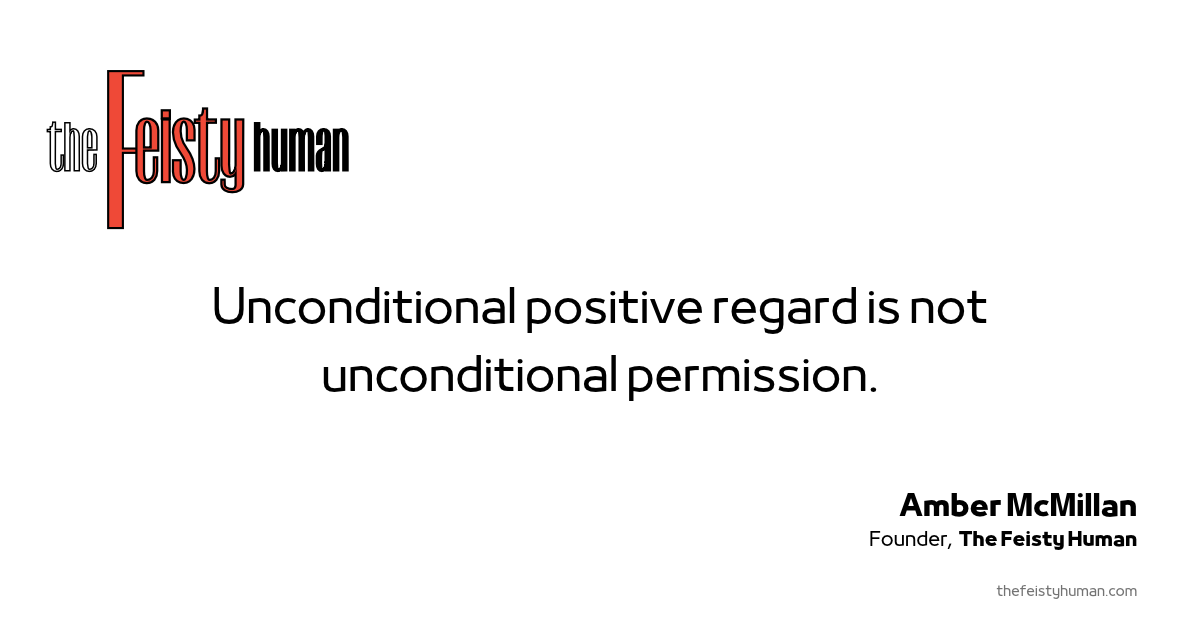
Unconditional positive regard is not unconditional permission.
I can believe in your inherent worth and still hold you accountable for your choices.
I can respect your humanity and still challenge your behaviour.
I can offer you compassion without giving you unlimited access to my time, energy or attention.
And I can say no without turning you into a villain.
Imagine what might change if we stopped treating boundaries as declarations of hostility.
What if a boundary could simply be an honest expression of what we are willing and able to do?
What if we didn't need to prove that someone else was wrong before giving ourselves permission to make a different choice?
Now there's a thought.
Leaders, This One's for You Too
This isn't only about personal relationships.
It shows up in organizations every single day.
A leader understands why an employee is struggling and feels compelled to lower expectations indefinitely.
A team member recognizes that a colleague is overwhelmed and quietly absorbs more and more work.
A manager avoids a difficult conversation because they don't want to appear insensitive.
And before long, compassion has become confused with the absence of accountability.
But that's not particularly compassionate to anyone.
Not to the person who needs clarity.
Not to the colleagues carrying an uneven burden.
And not to the leader who is now trying to manage an increasingly unsustainable situation.
Human-centred leadership doesn't mean avoiding difficult decisions.
It means making those decisions without forgetting the humanity of the people affected.
Sometimes the most respectful thing we can offer someone is a clear expectation, an honest conversation or a thoughtful no.
Not because we care less.
Because we care enough to be truthful.
You Don't Have to Make Someone Wrong to Choose Yourself
This might be the part I care about most.
For years, many of us have operated as though we need a compelling argument before we're allowed to say no.
We assemble evidence.
We justify our discomfort.
We rehearse explanations.
We wait until we're exhausted, resentful or completely overwhelmed before finally deciding that something has to change.
And even then, we feel compelled to convince everyone else that our decision is reasonable.
But what if you didn't?
What if someone could be a perfectly decent human being and still not be the right person for you to spend time with?
What if an opportunity could be genuinely wonderful and still not be yours to pursue?
What if someone could need your help and you could still be unable to provide it?
What if your no didn't require a prosecution of someone else's character?
You can honour another person's humanity without negotiating away your own.
That's not selfishness.
That's self-trust.
And self-trust is something we develop through practice, not simply by understanding the concept.
A Feisty Invitation
This is part of the work behind The Feisty Human and the reason I created Feisty Foundations.
Because recognizing these patterns is one thing.
Learning to interrupt them in real life is another.
Feisty Foundations is an opportunity to explore the assumptions, expectations and habits that shape how you see yourself, make decisions and navigate your relationships with others.
And our January 2027 open cohort is now accepting registrations.
If you've been exploring these conversations with me and finding yourself thinking, “I understand what she's saying, but how do I actually live it?” — this might be your next step.
You can explore Feisty Foundations and the January cohort through The Feisty Human website.
And if you'd rather begin with the philosophy at your own pace, my book, The Feisty Human: Recipes for Becoming Someone You Don't Have to Negotiate, is available there too.
This Week's Feisty Challenge
Think about a situation where you've been saying yes because you understand why someone wants or needs something from you.
Now ask yourself:
If I could care about this person without being responsible for their reaction, what would I choose?
You don't necessarily need to change your answer.
But you deserve to know whether it's actually yours.
And here's the question I'd love to explore together:
Have we become so committed to being understanding that we've forgotten how to be honest about our own limits?
Or is there a perspective I'm missing?
I welcome the challenge.
Because we can be fierce with ideas and generous with people.
And sometimes, being generous with people includes being generous with ourselves.
Forward, with purpose.
Amber McMillan
The Feisty Human
If this reflection stayed with you, explore The Feisty Human: Recipes for Becoming Someone You Don’t Have to Negotiate.
Enjoyed this essay? Connect with me on LinkedIn or join the email list below to receive every new edition.
Maybe You're Not Being Silenced. Maybe You're Not Listening.
We've become comfortable talking about the importance of having a voice. But what happens when someone hears us, understands us and still disagrees? Sometimes disagreement is mistaken for disrespect, and sometimes being heard gets confused with being obeyed. A feisty exploration of listening, leadership and the courage to consider perspectives other than our own.
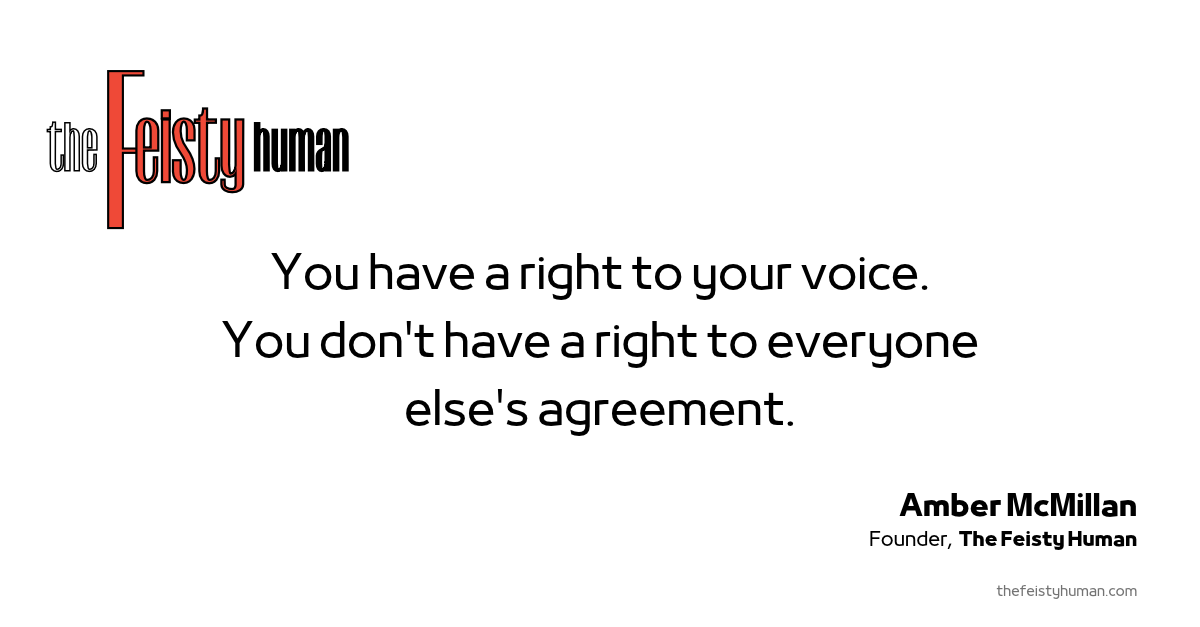
You have a right to your voice. You don't have a right to everyone else's agreement.
I've been thinking about how often we hear people say they're being silenced.
It's a powerful accusation. And sometimes, a necessary one.
There are people whose voices are deliberately excluded from conversations, whose concerns are dismissed because of their identities or positions, and whose attempts to speak honestly come with very real consequences. I've seen what happens when people are punished for raising uncomfortable truths. It can be devastating, both personally and organizationally.
But I've also noticed something else.
Sometimes people say they're being silenced when what they actually mean is that someone disagreed with them.
And those are two very different experiences.
I wonder whether we've become so attached to the importance of having a voice that we've forgotten something equally important about communication.
Other people have voices too.
Being Heard Is Not the Same as Being Agreed With
Imagine you're in a meeting. You've made a recommendation, explained your reasoning and offered what you believe is a compelling argument.
Someone challenges your assumptions.
Another person offers a different interpretation of the information.
A third suggests that your recommendation might create unintended consequences.
You leave feeling frustrated. Perhaps even dismissed.
But were you silenced?
Or did you participate in a conversation where other people exercised the same freedom to contribute that you expected for yourself?
It's worth asking because disagreement can feel remarkably personal, particularly when we've invested significant time, expertise or identity in an idea.
I've experienced that myself.
When you've spent years developing expertise, it's easy to become confident in your ability to recognize the right course of action. That confidence can be useful. It can also make challenges feel less like invitations to think and more like obstacles to overcome.
And sometimes, the louder we insist that nobody is listening to us, the less attention we're paying to what they're actually saying.
That's an uncomfortable possibility.
But an important one.
Listening Is Not Surrender
Somewhere along the way, I think we've developed an unfortunate relationship with disagreement.
We treat conversations as contests. Someone wins. Someone loses. Someone is right. Someone is wrong.
And if we listen too carefully to an opposing perspective, perhaps we're afraid we'll appear uncertain about our own.
But listening isn't surrender.
It doesn't require agreement, endorsement or even compromise.
It requires enough curiosity to understand what another person is actually communicating before deciding what to do with it.
That sounds simple.
It isn't always easy.
Especially when the subject matters deeply to us.
Especially when the other person's perspective challenges something we've believed for a long time.
Especially when we're accustomed to being the person others look to for answers.
The ability to remain curious under those circumstances is a form of leadership maturity that deserves considerably more attention.
Because being willing to listen doesn't diminish our expertise.
It makes our expertise more useful.
Leadership Changes the Stakes
This distinction becomes especially important when we're in positions of authority.
A leader can genuinely believe they're encouraging open dialogue while unintentionally making disagreement difficult.
Perhaps they respond defensively when challenged. Perhaps they explain why an idea won't work before asking what prompted it. Perhaps they interpret persistent questions as resistance rather than curiosity.
And perhaps, after several experiences like that, people stop offering their perspectives altogether.
The leader might then conclude that the team lacks initiative or isn't contributing enough.
But what if the silence is information?
What if people have learned that speaking up carries a cost?
That's a very different problem from someone being unhappy because their recommendation wasn't accepted.
And we need to be able to distinguish between the two.
Psychological safety doesn't mean every idea receives approval. It means people can raise concerns, ask questions, acknowledge mistakes and offer different perspectives without being humiliated or punished for doing so.
A psychologically safe team can still disagree vigorously.
In fact, it probably should.
The goal isn't universal agreement.
It's creating conditions where disagreement can improve the quality of our decisions rather than threaten our relationships.
When We Confuse Disagreement With Disrespect
Here's something I find fascinating about our growing insistence on being heard.
We want people to respect our perspectives, acknowledge our experiences and make room for our voices.
But what happens when someone listens carefully, understands exactly what we're saying, and still disagrees?
Have they failed to hear us?
Or have we confused being heard with being obeyed?
Because sometimes the person accusing everyone else of silencing them is the person leaving the least room for anyone else's voice.
That's uncomfortable.
And I think it's worth examining.
Not because people don't deserve to be heard. They absolutely do.
But because everyone else deserves that same consideration.
Including the people whose perspectives make us uncomfortable.
Someone can understand your position and still reject your recommendation.
Someone can care about your experience and still see the situation differently.
Someone can listen carefully and still say no.
That doesn't automatically make them dismissive.
It makes them a separate human being with their own judgment.
And perhaps respecting that separation is part of what genuine listening requires.
The Courage to Be Changed by a Conversation
Here's the question I've been sitting with.
When was the last time you entered a conversation genuinely willing to leave with a different perspective?
Not simply willing to let someone else speak.
Not waiting politely for your turn to respond.
But actually willing to discover something you hadn't considered.
I think that's a much higher standard of listening than most of us practise consistently.
And I include myself in that observation.
Because listening well requires something that can feel surprisingly risky.
It requires us to accept that our understanding might be incomplete.
That our interpretation might be flawed.
That another person's experience might reveal something our own has not.
None of that means abandoning our values or surrendering our judgment.
It means recognizing that understanding is something we develop, not something we permanently possess.
And the more certain we become that we've already understood everything worth understanding, the less likely we are to learn anything new.
A Feisty Invitation
The next time you leave a conversation feeling unheard, I invite you to consider a few questions before deciding what happened.
Did I have an opportunity to express my perspective?
Was my contribution considered, even if it wasn't accepted?
Did I make an effort to understand the perspectives offered in return?
And perhaps the feistiest question of all:
Was I hoping to be understood, or was I hoping to be agreed with?
Those aren't the same thing.
Sometimes the answer will reveal that you genuinely weren't given a fair opportunity to contribute. If that's the case, it deserves attention and action.
But sometimes it might reveal that you were heard.
You just weren't agreed with.
And perhaps the most important thing we can do in that moment is resist the temptation to turn disagreement into an accusation.
Because having a voice doesn't mean owning the conversation.
And being heard doesn't mean having the final word.
Maybe you're not being silenced. Maybe you're not listening.
It's a provocative thought.
And one I'm willing to have challenged.
Forward, with purpose.
The Feisty Human
If this reflection stayed with you, explore The Feisty Human: Recipes for Becoming Someone You Don’t Have to Negotiate.
Enjoyed this essay? Connect with me on LinkedIn or join the email list below to receive every new edition.
Your Boundaries Are Not Everyone Else's Instructions
We've become remarkably comfortable talking about boundaries. But sometimes what we call a boundary is actually an attempt to control someone else's behaviour. What happens when protecting our peace becomes a way of avoiding disagreement? Let's explore the difference between healthy boundaries, reasonable requests and demands disguised as self-protection.
When protecting your peace starts looking suspiciously like controlling someone else's behaviour.
I've been thinking about boundaries lately. Not because I believe we need fewer of them, but because I'm beginning to wonder whether we've become so enthusiastic about setting them that we've forgotten what they're actually for.
Boundaries have become part of our everyday vocabulary. We hear about them in leadership conversations, relationships, workplaces and social media feeds. We're encouraged to establish them, communicate them, defend them and, when necessary, walk away from anyone who refuses to respect them.
Much of that advice is valuable. Some of it is even liberating.
But somewhere along the way, I think we've started confusing boundaries with instructions.
And that distinction matters.
A Boundary Is About What I Will Do
Imagine someone repeatedly interrupts you during meetings. You're frustrated, understandably. You want to contribute, and you deserve the opportunity to finish a thought without being talked over.
You might say, "My boundary is that you need to stop interrupting me."
Except that's not really a boundary. That's a request about someone else's behaviour. A perfectly reasonable request, perhaps, but still a request.
A boundary sounds different.
"When I'm interrupted, I'll ask to finish my thought. If the interruptions continue, I'll raise the issue with the meeting facilitator or choose a different way to contribute."
Notice the difference?
The first statement places responsibility for your boundary entirely in someone else's hands. The second identifies what you will do to protect your ability to participate.
One attempts to direct another person's behaviour. The other establishes your own response.
This doesn't mean we shouldn't ask people to change their behaviour. Of course we should. Healthy relationships and effective teams depend on people being willing to listen, negotiate and adjust.
But asking someone to change isn't the same as setting a boundary. And calling a demand a boundary doesn't magically make it one.
When the Language of Self-Protection Becomes a Tool of Control
Here's where things get particularly interesting.
We live in a time when psychological language is increasingly accessible. Words like triggered, toxic, gaslighting, trauma and boundaries have moved from specialized conversations into everyday discourse.
Greater awareness can be a wonderful thing. Language helps us recognize experiences we may previously have struggled to describe.
But language can also give us a sense of authority we haven't necessarily earned.
When someone says, "You're violating my boundaries," the conversation can suddenly become difficult to challenge. Nobody wants to be the person accused of disrespecting someone's emotional safety.
And yet, what if the so-called boundary is actually an expectation that another person agree with us? What if it's a demand that they avoid difficult questions, suppress their opinions or organize their behaviour around our discomfort?
Discomfort isn't always evidence of harm.
Sometimes discomfort is what happens when another human being has a different perspective, a competing need or the audacity to say no.
That's not automatically a violation.
That's being human together.
Leadership Makes This Even More Complicated
In leadership, boundaries are essential. We need clarity around responsibilities, availability, decision-making authority, respectful conduct and the limits of what people can reasonably be expected to give.
But leaders also have power.
And power changes the equation.
A leader who says, "My boundary is that I won't tolerate negativity," might believe they're protecting a positive workplace culture. Their team, however, may hear something entirely different: disagreement is unwelcome, difficult feedback is dangerous and raising concerns could carry consequences.
Suddenly, a boundary becomes a convenient way to silence people.
I've seen variations of this throughout my career. I've also had to confront the ways my own certainty and expectations have influenced the people around me.
It's remarkably easy to believe we're protecting something important when we're actually protecting ourselves from being challenged.
That realization isn't particularly comfortable.
But it's useful.
A leader can establish standards for respectful communication without demanding emotional agreement. They can insist on accountability without requiring enthusiasm. They can create expectations around professional conduct while leaving room for disagreement, frustration and honest questions.
The distinction is between creating conditions for people to work together and attempting to control how everyone experiences those conditions.
One is leadership.
The other may simply be control dressed in more fashionable language.
And Sometimes a Boundary Really Does Mean Leaving
I want to be careful here because the distinction I'm making should never become an excuse to dismiss someone's need for protection.
There are circumstances where another person's behaviour is harmful, threatening, abusive or persistently disrespectful. In those situations, a boundary may involve limiting contact, reporting misconduct, ending a relationship or removing yourself from an environment altogether.
You do not have to negotiate your safety to prove you're reasonable.
Nor does setting a boundary require giving someone unlimited opportunities to demonstrate that they won't respect it.
But even then, the boundary concerns the choices available to you. It establishes what you will accept, what you will do and what consequences follow from continued behaviour.
It doesn't give you ownership over another person's decisions.
And sometimes that is the hardest part.
We can communicate clearly, act consistently and make thoughtful choices about our own participation. We cannot guarantee that someone else will understand, agree or change.
A boundary isn't a promise that other people will behave differently.
It's a commitment to how we will respond if they don't.
The Question Worth Asking
Before announcing a boundary, I wonder what might happen if we asked ourselves a few uncomfortable questions.
Am I identifying something I need to protect, or am I trying to make someone else more comfortable for me to deal with?
Am I prepared to take responsibility for my own response, or am I placing that responsibility on someone else?
Am I communicating a limit, making a request or issuing an ultimatum?
And perhaps most importantly, am I willing to extend the same respect for another person's autonomy that I'm asking them to extend to mine?
Because other people have boundaries too.
They get to disagree. They get to decline. They get to decide that the relationship, arrangement or expectation no longer works for them.
That doesn't automatically make either person the villain.
It makes them two humans navigating the complicated business of being separate people.
And I think that's where some of our most important growth happens.
Not in learning how to make everyone respect our boundaries, but in learning how to respect ourselves without attempting to manage everyone else.
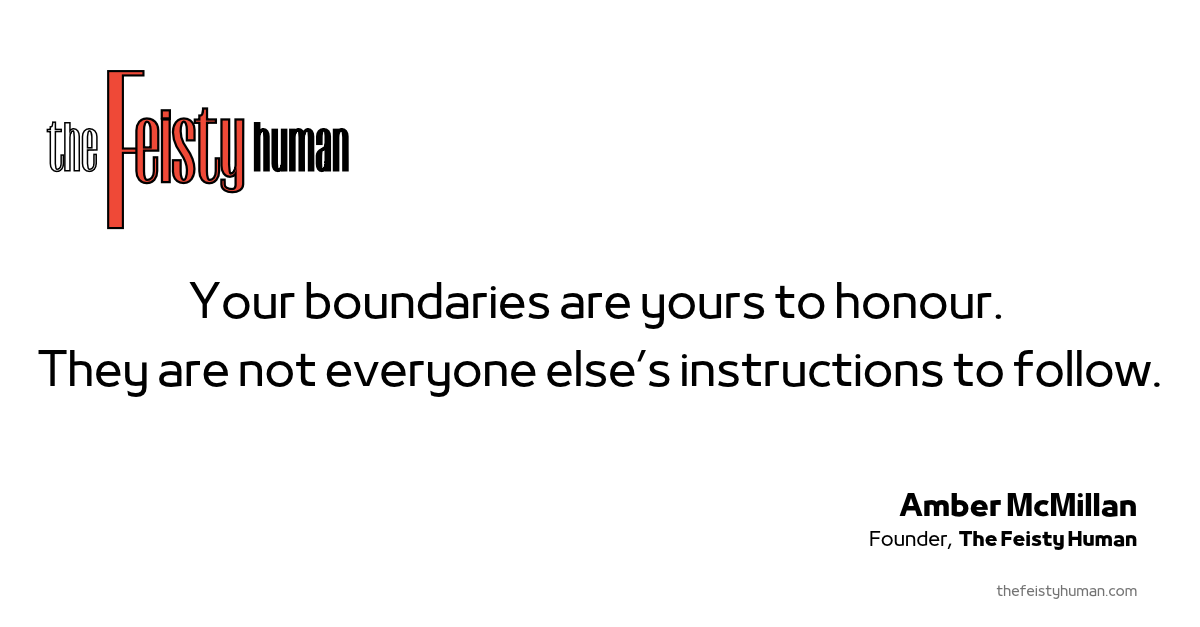
Your boundaries are yours to honour. They are not everyone else's instructions to follow.
That's not an argument against boundaries.
It's an invitation to practise them with a little more clarity, humility and responsibility.
And perhaps a little more feistiness.
Forward, with purpose.
The Feisty Human
If this reflection stayed with you, explore The Feisty Human: Recipes for Becoming Someone You Don’t Have to Negotiate.
Enjoyed this essay? Connect with me on LinkedIn or join the email list below to receive every new edition.

What if you’re the problem?
I spent a considerable portion of my life being right—even when I wasn't. What happens when experience becomes certainty, bias narrows our vision, and the problem we're trying to solve might actually involve us?
I have a confession. I have spent a considerable portion of my life being right. Even when I wasn't.
It's a remarkable talent, really. And one that took me far too long to recognize wasn't quite the leadership strength I thought it was.
For years, I carried biases that narrowed my vision. I had opinions informed by experience, convictions reinforced by success, and enough confidence to make a compelling argument for almost anything I believed. I wasn't deliberately trying to be difficult. I genuinely believed I understood what was happening around me.
And sometimes, I was just plain wrong.
The uncomfortable part wasn't discovering that I could be wrong. We all know that intellectually. The uncomfortable part was recognizing how much energy I had invested in being right, how readily I could defend my position, and how little room that sometimes left for another perspective.
I had spent years learning about leadership, communication, conflict and change. I could recognize resistance in others, identify dysfunctional patterns and explain why people struggled to see beyond their assumptions.
Apparently, I was also quite capable of demonstrating those very behaviours myself.
Funny how that works.
When Confidence Becomes a Blind Spot
Experience is a wonderful teacher, but it can also make us remarkably confident in conclusions we haven't examined recently.
We develop ways of interpreting the world. We notice patterns, draw on previous experiences and make judgments about what is happening and why. Much of the time, this serves us well. Without those mental shortcuts, we'd struggle to make even ordinary decisions.
But those same shortcuts can become barriers to understanding.
We begin to see what we expect to see. We interpret someone's behaviour through the lens of what we already believe about them. We listen for confirmation rather than information. And when someone challenges our interpretation, we may become more interested in defending our position than understanding theirs.
I know I've done this.
I've walked into conversations convinced I understood the problem before everyone had finished explaining it. I've mistaken my intentions for my impact. I've believed that because I cared deeply about an outcome, my approach must surely be the right one.
And I've occasionally been so committed to making my point that I missed the point someone else was trying to make.
Here's something I've learned:
Certainty can feel like clarity when it's actually a blind spot.
The challenge is that blind spots rarely announce themselves. They feel like knowledge, experience, intuition or good judgment. Sometimes they even come dressed as principles.
What If the Problem Isn't Them?
One of the most convenient things about being human is our ability to identify what other people need to change.
The colleague who won't listen. The leader who doesn't understand. The partner who always reacts the same way. The team member who can't seem to see the bigger picture.
We can become remarkably skilled at diagnosing everyone else's contribution to a difficult situation while remaining surprisingly incurious about our own.
I certainly could.
And here's where my own development became uncomfortable. I began recognizing that some of the problems I was experiencing weren't simply happening around me. I was contributing to them.
My assumptions influenced my reactions. My reactions influenced other people's responses. My certainty sometimes closed conversations that curiosity might have opened.
I wasn't necessarily responsible for everything that happened. Other people still had agency, choices and accountability of their own.
But I was responsible for me.
And until I became willing to examine my own contribution, I couldn't make meaningful progress.
That's a difficult admission for someone who has spent much of her life helping other people navigate change.
Expertise doesn't exempt us from being the problem. Sometimes it just makes us better at explaining why we're not.
Ouch.
Being Wrong Isn't the Same as Being Worthless
There's a reason this kind of self-examination can be so difficult.
When we've built an identity around being knowledgeable, capable or dependable, admitting we're wrong can feel like surrendering something much bigger than an opinion.
It can feel like surrendering credibility, authority or even belonging.
So we defend. We rationalize. We explain our intentions. We gather evidence that supports our interpretation and quietly discount evidence that doesn't.
Not necessarily because we're arrogant or malicious, but because being wrong has become threatening.
And this is where my understanding of human worth changed how I approached personal development.
I could be wrong without being worthless.
I could recognize bias without concluding I was a terrible person. I could acknowledge that my behaviour had negatively affected someone without making my entire identity the subject of the conversation.
In fact, separating my worth from my performance made it easier to take responsibility for my performance.
I no longer needed every difficult conversation to end with evidence that I was right.
Sometimes, I needed to learn something.
The Practice of Being Wrong
I wish I could tell you that once I recognized these patterns, they disappeared.
They didn't.
I still carry biases. I still make assumptions. I still have moments when my first instinct is to defend rather than understand. And I still occasionally discover that my certainty has travelled considerably farther than the evidence supporting it.
The difference is that I'm becoming more willing to notice.
I'm learning to ask myself what I might be missing. Whether I've confused my interpretation with a fact. Whether I'm responding to what someone actually said or to the story I've constructed about what they meant.
And perhaps most importantly, whether I'm genuinely interested in understanding another perspective or simply waiting for an opportunity to explain why mine is correct.
None of this requires abandoning conviction. We can have strong opinions, make difficult decisions and stand firmly behind our values while remaining open to the possibility that our understanding is incomplete.
Being feisty doesn't require being right.
Sometimes it requires having the courage to discover that we're not.
An Uncomfortable Invitation
This week, I want to offer you a challenge.
Think about a situation in your life where you've been frustrated by someone else's behaviour. Perhaps it's a colleague, a family member, a leader or someone whose decisions seem completely unreasonable to you.
Now, instead of asking what they need to change, ask yourself three questions.
What am I assuming that I haven't actually verified?
How might my behaviour be contributing to the dynamic I'm experiencing?
And what would I have to reconsider if I discovered that my interpretation was wrong?
You may find that your original assessment was entirely reasonable. Sometimes other people really are behaving badly, and recognizing our own contribution doesn't mean accepting responsibility for theirs.
But you might also discover something that changes the conversation.
I know I have.
And I continue to.
Because the most important thing I've learned about being wrong is that it doesn't have to be the end of my credibility.
Sometimes, it's the beginning of my growth.
What if the thing standing between you and your next stage of growth isn't what you don't know, but what you're absolutely certain you do?
Forward, with purpose.
— Amber
Your performance can be evaluated. Your worth cannot.
If this reflection stayed with you, explore The Feisty Human: Recipes for Becoming Someone You Don’t Have to Negotiate.
Enjoyed this essay? Connect with me on LinkedIn or join the email list below to receive every new edition.