

The Version of You That Got Rewarded
What happens when a behaviour that earned trust, approval or belonging becomes an identity you believe you must maintain? This week, The Feisty Human explores the helper/fixer persona—and the difference between a real strength and a role you no longer feel free to leave.
There is a version of me who knows how to make things work. Give her a problem and she will find the gap. Give her a struggling team and she will create structure. Give her a difficult conversation and she will help everyone find the words. Give her something broken, confusing, unfinished or falling apart—and she will get to work.
That version of me has been very useful. She has also been heavily rewarded.
People trusted her. They relied on her. They described her as capable, resourceful and strong. They gave her more responsibility because she had already demonstrated that she could carry it. Somewhere along the way, a behaviour that worked became an identity I believed I had to maintain.
This worked. Therefore, this is who I need to be.
Rewarded Behaviours Become Roles
Most of our professional personas do not appear out of nowhere. They form around something that worked.
Maybe you were praised for being easygoing, so you became the person who never made things difficult. Maybe people admired your independence, so you stopped letting them see when you needed help. Maybe you were rewarded for producing exceptional work, so “excellent” quietly became the minimum you would allow yourself to deliver.
Maybe you became known as the calm one, the strong one, the smart one, the dependable one or the person who could always find a solution.
None of those qualities are bad. That is what makes these identities so difficult to notice. They often begin as real strengths.
The problem is not that you learned how to help, achieve, lead, organize, solve or endure. The problem begins when the behaviour stops being something you can choose and becomes something you believe you must perform in order to remain valuable.
The Helper Has to Be Needed
The helper/fixer version of me did not simply enjoy being useful. She learned to locate herself through usefulness.
If something needed doing, I knew where I belonged. If someone needed support, I knew what I could offer. If a problem appeared, I could move toward it with confidence. Problems gave me something concrete to solve, and other people’s needs gave me a role I understood.
Being effective in that role created its own kind of evidence: I am needed. I am contributing. I am valuable here.
There was rarely time to examine that evidence. Being needed creates its own momentum. There is always another problem, another person or another situation asking for attention. Reflection becomes something you will do later, when everything settles down.
But everything rarely settles down for a skilled helper. If one situation no longer needs you, it is remarkably easy to find another that does.
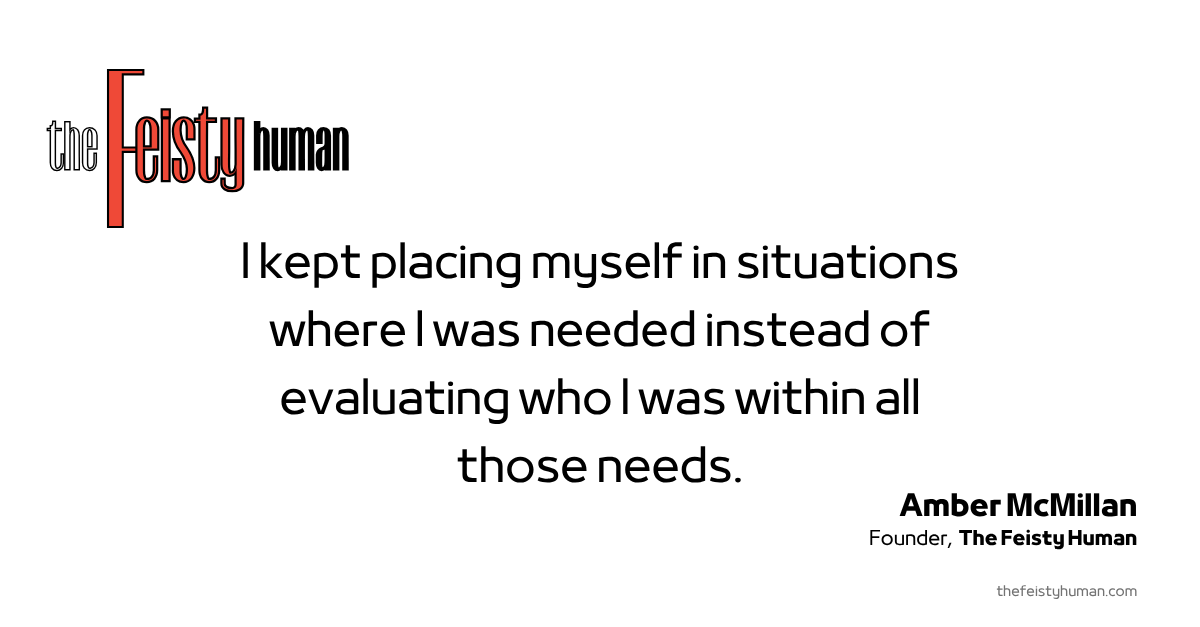
I did not spend much time evaluating who I was within all those needs. I kept placing myself in situations where I was needed instead. The next problem protected me from having to ask what remained when there was nothing for me to fix.
That is the hidden bargain of the helper/fixer persona. It gives you a clear role while quietly making stillness feel unfamiliar.
If I locate my value in being the person who helps, what happens when nobody needs my help? If I understand myself as the fixer, what happens when something cannot—or should not—be fixed by me? If usefulness becomes part of my identity, can I still feel steady when the most honest thing I can say is:
This is not mine to carry.
The Persona Is Not a Lie
It would be easy to describe these professional personas as false selves we need to discard. I do not think that is quite right.
The helper is real. The achiever is real. The dependable person, the peacemaker, the expert and the one who gets things done are all real. They reflect abilities we developed, choices we made and ways we learned to contribute.
But a real part of us can still become an exhausting role when we believe we are not allowed to step outside it.
The persona is not necessarily a lie. It is simply incomplete.
I can be helpful without being responsible for everything. I can recognize a solution without being the person who must implement it. I can care deeply about someone without taking ownership of their outcome. I can allow something to remain unfinished without treating that as evidence that I have failed.
Those distinctions sound simple. Living them is different.
What Did the Room Reward?
Think about the version of you that has been most successful in your professional life. What does that person know how to do? What do people consistently praise them for? What do others expect them to carry?
And what happens inside you when you cannot—or no longer want to—perform that role?
This is not an invitation to reject your strengths. It is an invitation to notice the agreement that may have formed underneath them:
I will be the capable one. I will keep the peace. I will find the answer. I will not need too much. I will make this easier for everyone else.
And in return, I will be valued here.
Most of us never consciously agreed to those terms. We simply noticed what worked and kept doing it.
This Week’s Practice
Complete this sentence:
I learned that people valued me when I was the one who ____________.
Do not overthink it. Notice the first answer that appears.
Then ask yourself:
Is this still something I choose—or something I believe I have to keep performing?
You do not have to stop being helpful, capable, reliable or strong. You do not have to reject the version of you that helped you build your life.
But you are allowed to become more than the behaviour that once earned the room’s approval.
The version of you that got rewarded may be real.
It was never the whole of you.
Forward, with purpose,
Amber
Download Chapter Eleven of The Feisty Human and continue the conversation.
Enjoyed this essay? Connect with me on LinkedIn or join the email list below to receive every new edition.